Free body diagrams
A free-body diagram (FBD) is a simple sketch of a particle or object that shows all the forces acting on it. By isolating the body and replacing its surroundings with force vectors, we create a clear starting point for writing the equilibrium equations.
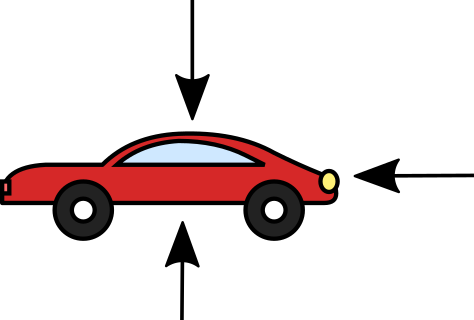
Free Body Diagrams Overview
Free-body diagrams are the most important step in beginning a statics analysis. They isolate the particle or body from its surroundings and show all external forces acting on it. Each force is represented by an arrow drawn in the correct direction and applied at the appropriate point. An FBD should include only the body of interest and the forces acting on it, not the surrounding structure or unnecessary geometry. Once the diagram is complete, the equilibrium equations can be written directly from the forces shown.
Types of Forces
In order to construct an accurate free-body diagram, it is important to recognize the forces that commonly appear in statics problems. The most frequently encountered types are shown below.
Applied Forces
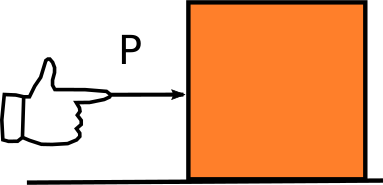
An applied force is a force applied to a body by a person, another object, or a machine.
Normal Force
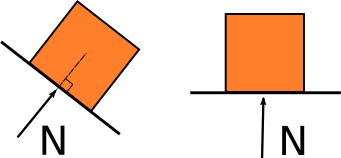
A normal force is the reaction force exerted by a surface on a body in contact with it. The force always acts perpendicular to the surface.
Weight

Weight is the gravitational force exerted by the Earth on a body. It acts vertically downward through the center of mass and has magnitude W = mg, where m is the mass and g is the acceleration due to gravity.
Tension Forces

Tension is the force transmitted through a cable, rope, or chain when it is pulled tight. The force acts along the length of the cable and always pulls away from the body.
Spring Forces

A spring force is generated when a spring is stretched or compressed. The force acts along the axis of the spring and is proportional to the deformation according to Hooke’s Law, F = kx. The force acts in a direction that tends to restore the spring to its natural (unstreched/uncompressed) length.
Friction Forces

Friction is a force that resists relative motion between two surfaces in contact. It acts parallel to the contact surface and opposite the direction of motion or impending motion.