Vector Resolution
Vector resolution is the process of expressing a vector as the sum of component vectors acting along specified directions. The directions may be chosen arbitrarily, though rectangular components are used most often in statics.
Vector Resolution — Definition
Vector resolution is the process of decomposing a vector into component vectors that act along selected directions. These component vectors combine to produce the original vector.
A vector \(\mathbf{V}\) may be written as the vector sum of its components along the chosen directions.
Graphical Method of Vector Resolution
Vector resolution may be performed graphically by constructing a parallelogram. Lines are drawn through the head of the vector parallel to the chosen directions. The sides of the parallelogram represent the component vectors.
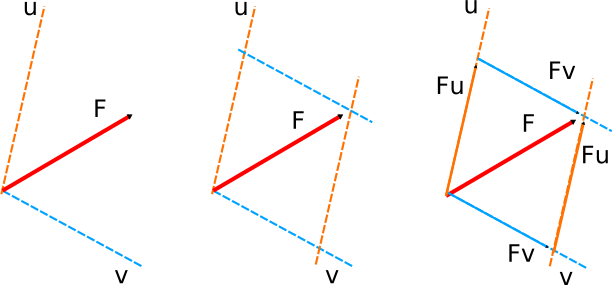
Rectangular Components in 2D
Rectangular components are a special case of vector resolution in which the component directions are perpendicular.
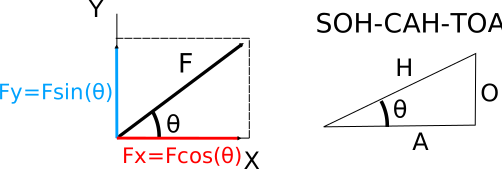
When a vector is resolved along orthogonal \(x\)- and \(y\)-axes, the components and the original vector form a right triangle. This allows the component magnitudes to be computed directly using trigonometry.
Worked Example — Resolving a Force Along Different Axes
Problem
A force of magnitude \(100\,\text{lb}\) acts at an angle of \(40^\circ\) above the positive \(x\)-axis. Resolve the force:
- along the \(x\)- and \(y\)-axes, and
- along the rotated \(x'\)- and \(y\)-axes, where the \(x'\)-axis is rotated \(30^\circ\) clockwise from the \(x\)-axis.
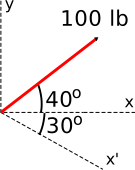
When the force is resolved along the standard \(x\)–\(y\) axes, the components and the force form a right triangle. This allows the component magnitudes to be obtained directly using basic trigonometric relations.
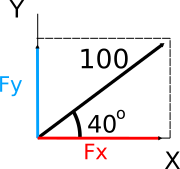
To resolve the \(100\,\text{lb}\) force along the rotated axes, we construct a force–component triangle using the directions of the \(x'\)- and \(y\)-axes. Because the force is not perpendicular to either axis, the components do not form a right triangle with the force.
Instead, the force vector and its components form a force triangle, which must be analyzed using the law of sines.
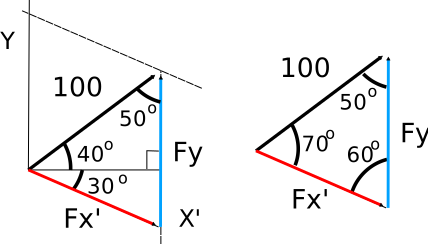
From the diagram, the force direction is offset from the reference direction by \(40^\circ\), and the \(x'\)-axis is rotated an additional \(30^\circ\) from the same reference. Therefore, the angle between the force vector \(\mathbf{F}\) and the positive \(x'\)-axis is:
\[ \theta' = 40^\circ + 30^\circ = 70^\circ \]The interior angles of the component triangle are obtained directly from the geometry:
- Angle opposite \(F_{x'}\): \(50^\circ\)
- Angle opposite \(F_{y}\): \(60^\circ\)
- Angle opposite \(F\): \(70^\circ\)
Applying the law of sines to the triangle:
\[ \frac{F_{x'}}{\sin(50^\circ)} = \frac{100}{\sin(60^\circ)} \] \[ F_{x'} = 34.2\,\text{lb} \] \[ \frac{F_{y}}{\sin(70^\circ)} = \frac{100}{\sin(60^\circ)} \] \[ F_{y} = 94.0\,\text{lb} \]- \(F_x = 76.6\,\text{lb}\), \(F_y = 64.3\,\text{lb}\)
- \(F_{x'} = 34.2\,\text{lb}\), \(F_{y} = 94.0\,\text{lb}\)