Vector Overview
Many quantities in statics can be described by a single number, while others require both a magnitude and a direction. In this section we distinguish between scalars and vectors and look at common ways of writing vector quantities.
Scalars
Scalars are quantities that are fully described by a single number representing their magnitude. They have no associated direction. Typical scalar quantities in mechanics include:
Time

Temperature

Mass

Vectors
Vectors are distinct from scalars because they have both magnitude and direction. A vector describes not only “how much” but also “where”.
Force

Velocity
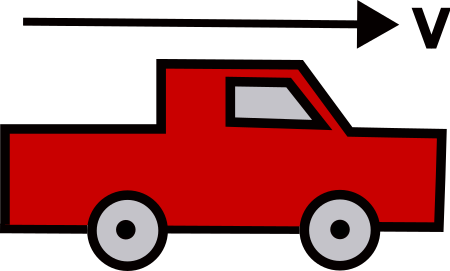
Graphical Representation of a Vector
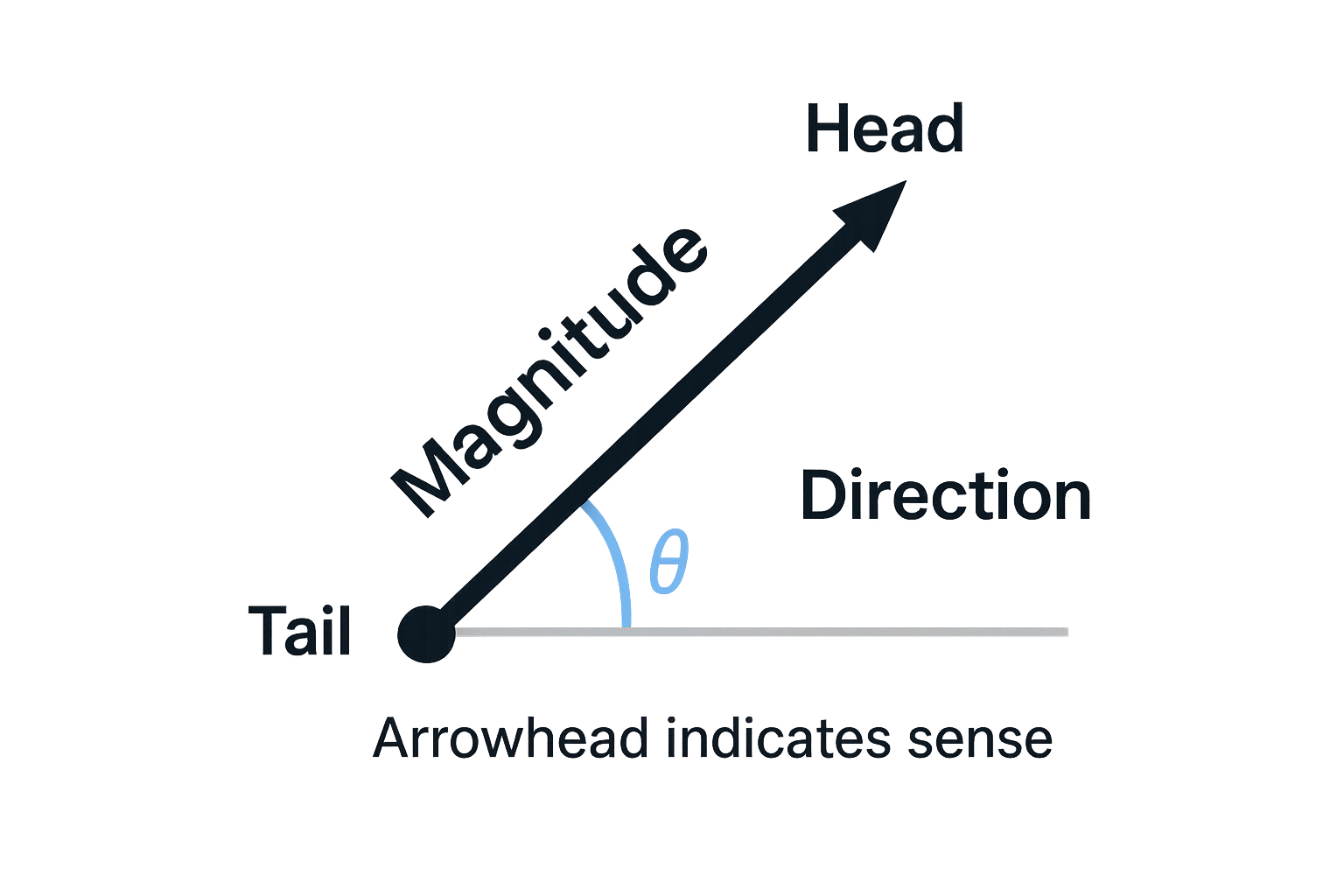
Vectors are often represented as arrows: the length of the arrow corresponds to the magnitude, and the arrowhead indicates the direction.
Common Notations for Vectors
Vectors can be represented in several notational styles:
- Bold font (e.g., \(\mathbf{A}\)) – commonly used in typed or printed documents to distinguish vectors from scalars.
- Arrow above the letter (e.g., \(\vec{A}\)) – a standard representation in physics and engineering texts.
- Line above or below the letter (e.g., \(\overline{A}\) or \(\underline{A}\)) – frequently used in example problems or handwritten notes when boldface is not convenient.