Position Vectors
A position vector specifies the location of a point relative to an origin. In statics, position vectors are used to build displacement vectors between points and to form unit direction vectors that define lines of action in 2D and 3D.
Definition
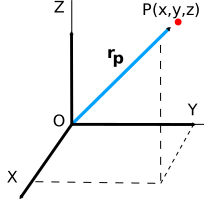
A position vector is a vector that starts at the origin and ends at the point. It describes where the point is located by giving its signed distances along the coordinate axes.
Cartesian Form
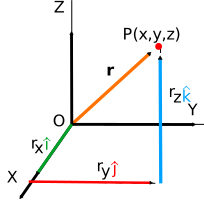
In Cartesian coordinates, a position vector is written using unit vectors \(\mathbf{i}\), \(\mathbf{j}\), and \(\mathbf{k}\).
Displacement Vectors Between Points
The displacement vector from point \(A\) to point \(B\) is obtained by subtracting the position vectors:
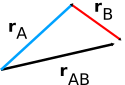
In component form, if \(\mathbf{r}_A = x_A\mathbf{i}+y_A\mathbf{j}+z_A\mathbf{k}\) and \(\mathbf{r}_B = x_B\mathbf{i}+y_B\mathbf{j}+z_B\mathbf{k}\), then:
Unit Direction Vector
A unit direction vector tells you which way something points, but not how large it is. Its length is always 1. It is found by taking a displacement vector and dividing by its length so that only the direction remains. If you later multiply this unit vector by a magnitude, you get back a full vector with both direction and size.
The magnitude of the displacement vector is: