Parallelogram Law
When two vectors act at a common point, their resultant may be determined graphically using the parallelogram law. This construction provides a clear geometric interpretation of vector addition and forms the basis for trigonometric solution methods used in statics.
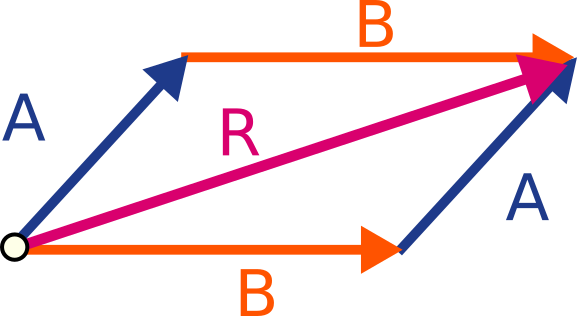
Parallelogram Law — Statement
If two vectors act from the same point, their resultant is represented by the diagonal of the parallelogram formed by drawing lines parallel to each vector through the tip of the other.
Parallelogram Properties
These geometric properties ensure that vectors may be translated without altering their magnitude or direction.
- Opposite sides are equal in length.
- Opposite interior angles are equal.
- The sum of the four interior angles is \(360^\circ\).
Graphical Construction of the Resultant
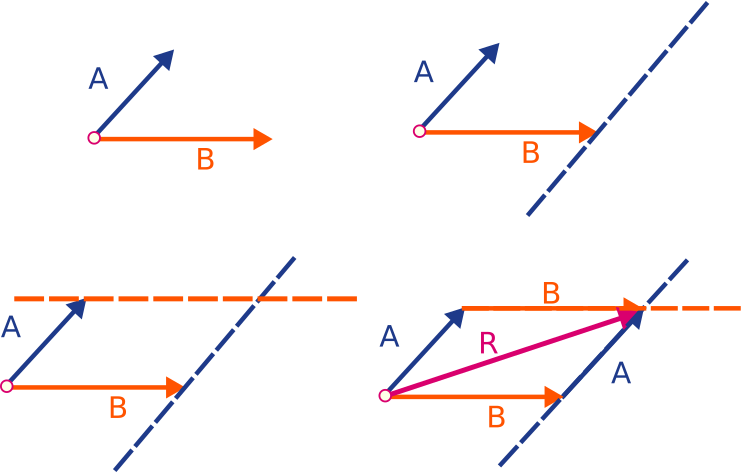
- Place vectors A and B tail-to-tail.
- Draw a line parallel to A through the tip of B.
- Draw a line parallel to B through the tip of A.
- The diagonal from the common tail represents the resultant R.
Trigonometric Solution of the Resultant
The triangle formed by the sides of the parallelogram may be analyzed using trigonometry to determine the magnitude and direction of the resultant vector.
Magnitude — Law of Cosines
If two vector magnitudes and the included angle are known, the magnitude of the resultant may be determined using:
\[ C^2 = A^2 + B^2 - 2AB\cos\gamma \]This relation is derived directly from the geometry of the parallelogram.
Direction — Law of Sines
Once the magnitude of the resultant is known, its direction relative to either vector may be obtained from:
\[ \frac{A}{\sin\alpha} = \frac{B}{\sin\beta} = \frac{C}{\sin\gamma} \]Use \(\alpha\) or \(\beta\) to describe the direction of the resultant relative to vector \(A\) or \(B\).
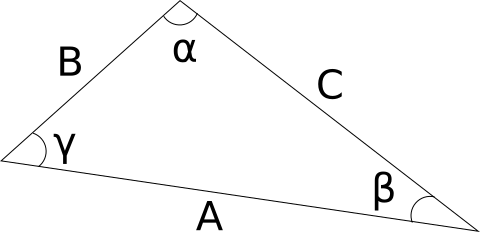
- Law of Cosines: Apply first when two sides and the included angle are known.
- Law of Sines: Apply first only when one side and all angles are known.
In most statics problems, the law of cosines is applied first, followed by the law of sines to determine direction.
Worked Example — Parallelogram Law
Problem
Two forces act at a point: \(F_1 = 80\,\text{lb}\) and \(F_2 = 60\,\text{lb}\). The included angle between the forces is \(120^\circ\). Determine the magnitude of the resultant \(|R|\) and its direction measured from the \(+x\)-axis.
Use the parallelogram law to form the equivalent triangle. Apply the law of cosines to compute \(|R|\), then apply the law of sines to compute the direction.
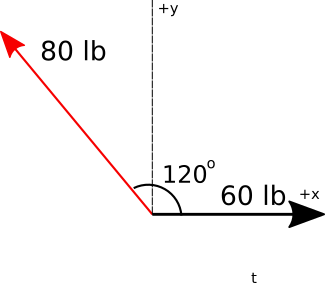
The parallelogram construction produces a triangle with sides \(60\), \(80\), and resultant \(R\). The included angle in the triangle is \(60^\circ\).
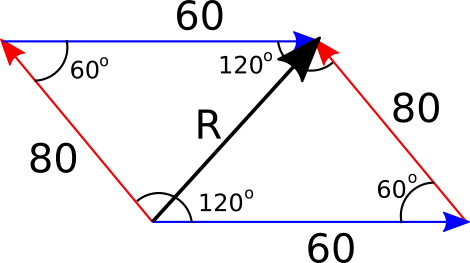
The \(60^\circ\) angle follows from parallelogram geometry: opposite interior angles are equal, and the sum of the four interior angles is \(360^\circ\).
\[ R = \sqrt{60^2 + 80^2 - 2(60)(80)\cos(60^\circ)} = 72.1 \text{lb} \]
Using the triangle,
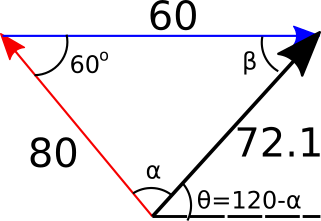
Once \(\alpha\) is known, the direction of the resultant measured from the horizontal is obtained from the geometry of the diagram:
\[ \theta = 120^\circ - \alpha = 73.9^\circ \]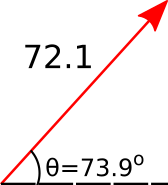
- \(|R| = 72.1\,\text{lb}\)
- \(\alpha = 73.9^\circ\) (from \(+x\))
Worked Example — Vertical Resultant
Problem
A 600 lb force acts at an angle of 60° from the positive \(x\)-axis. A second force \(F\) acts at an unknown angle \(\theta\). The two forces combine to produce a resultant of 1200 lb acting vertically upward.
Determine the value of \(\theta\) and the magnitude of \(F\).
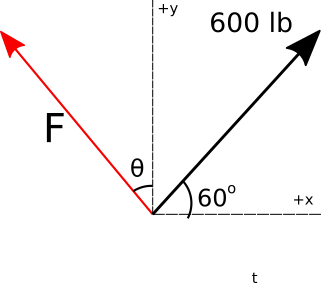
Construct the parallelogram using the \(600\,\text{lb}\) force at \(60^\circ\) from \(+x\) and the unknown force \(F\). The diagonal (resultant) is specified as \(R = 1200\,\text{lb}\) acting vertically upward.
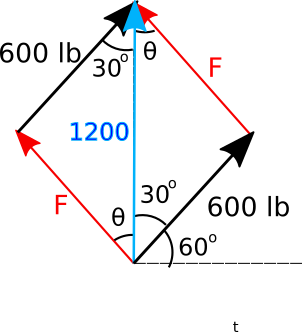
The included angle between the \(600\,\text{lb}\) force and the vertical resultant is:
\[ 30^\circ = 90^\circ - 60^\circ \]Analyze the triangle formed by the sides \(600\), \(1200\), and \(F\) with included angle \(30^\circ\).
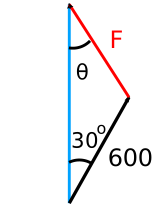
Apply the law of sines to the same triangle:
\[ \frac{600}{\sin\theta} = \frac{743.6}{\sin(30^\circ)} \] \[ \theta = 23.8^\circ \]- \(F = 743.6\,\text{lb}\)
- \(\theta = 23.8^\circ\)