Cartesian Vectors
Cartesian vector form expresses a vector using components along orthogonal axes. This representation replaces most geometric construction with component-wise algebra, which scales efficiently when many vectors are involved.
Cartesian Vectors
Graphical vector addition methods, such as the parallelogram law or the tip-to-tail method, are useful for visualizing a small number of vectors. As the number of vectors increases, these methods become cumbersome. For example, combining three forces requires applying the parallelogram law twice—first to obtain the resultant of two forces (R1 in the figure below), and then to combine that resultant with the third (R2).
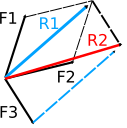
In Cartesian form, each vector is represented by its components along the \(x\)-, \(y\)-, and \(z\)-axes (\(\hat{\mathbf{i}}, \hat{\mathbf{j}}, \hat{\mathbf{k}}\)). Vector addition is performed by summing the corresponding scalar components along each axis.

2D Cartesian Components
In two dimensions, a vector is expressed using unit vectors \(\mathbf{i}\) and \(\mathbf{j}\) aligned with the \(x\)- and \(y\)-axes.
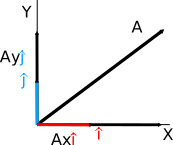
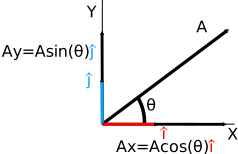
When a vector has known magnitude \(A\) and a defined reference angle \(\theta\), its Cartesian components are obtained from right-triangle geometry. The component adjacent to \(\theta\) uses cosine, and the component opposite \(\theta\) uses sine.
Magnitude and Angle in 2D
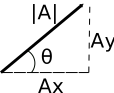
The magnitude of \(\mathbf{A}\) is obtained from the Pythagorean theorem and the direction angle \(\theta\) (measured from the positive \(x\)-axis) can be computed from: :
Worked Example — Cartesian Vector Notation
Problem
Two forces act at a point in the \(x\)-\(y\) plane.
- \(F_1 = 30\,\text{kN}\) directed \(30^\circ\) from the negative y axis.
- \(F_2 = 26\,\text{kN}\) directed along a \(5\!-\!12\!-\!13\) direction triangle in the negative x and positive y directions.
Determine the resultant \(\mathbf{R}\) (in Cartesian form), its magnitude, and the angle of \(\mathbf{R}\) measured from the \(+y\)-axis.
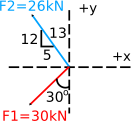
Write each force in Cartesian form \(\mathbf{F}=F_x\,\mathbf{i}+F_y\,\mathbf{j}\).
When the vector \(F_1\) is resolved into components, it points in the negative \(x\)- and negative \(y\)-directions. Therefore, both the \(x\)- and \(y\)-components are assigned negative signs.
\[ F_{1x} = -30\sin(30^\circ) = -15.0\ \text{kN} \] \[ F_{1y} = -30\cos(30^\circ) = -25.9\ \text{kN} \] \[ \mathbf{F}_1 = (-15.0\,\mathbf{i}-25.9\,\mathbf{j})\ \text{kN} \]The direction triangle represents how the force is oriented. The horizontal side divided by the hypotenuse gives the fraction of the force acting in the \(x\)-direction, and the vertical side divided by the hypotenuse gives the fraction acting in the \(y\)-direction. Multiplying these fractions by the force magnitude gives the components. The signs follow from the direction of the force.
\[ F_{2x} = -26\left(\frac{5}{13}\right) = -10.0\ \text{kN} \] \[ F_{2y} = 26\left(\frac{12}{13}\right) = 24.0\ \text{kN} \] \[ \mathbf{F}_2 = (-10.0\,\mathbf{i}+24.0\,\mathbf{j})\ \text{kN} \]Add components along each axis:
\[ R_x = F_{1x}+F_{2x} = -15.0-10.0 = -25.0\ \text{kN} \] \[ R_y = F_{1y}+F_{2y} = -25.9+24.0 = -1.9\ \text{kN} \] \[ \mathbf{R} = (-25.0\,\mathbf{i}-1.9\,\mathbf{j})\ \text{kN} \]Since the angle is referenced from \(+y\), use a right-triangle relationship based on the resultant components and add 90\(^\circ\). The acute angle \(\theta\) from the \(+y\)-axis satisfies \(\tan\theta = |R_x|/|R_y|\).
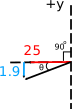
- \(\mathbf{R} = (-25.0\,\mathbf{i}-1.9\,\mathbf{j})\ \text{kN}\)
- \(|\mathbf{R}| = 25.1\ \text{kN}\)
- \(\theta = 94.3^\circ\) from the \(+y\)-axis (toward \(-x\))

3D Cartesian Components
In three dimensions, a vector is expressed using \(\mathbf{i}\), \(\mathbf{j}\), and \(\mathbf{k}\), aligned with the \(x\)-, \(y\)-, and \(z\)-axes.
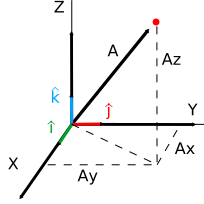
Magnitude, Direction Angles, and Direction Cosines in 3D
The magnitude of a 3D vector and the direction angles \(\alpha\), \(\beta\), and \(\gamma\), the angles between \(\mathbf{A}\) and the positive \(x\)-, \(y\)-, and \(z\)-axes, respectively, are given by:
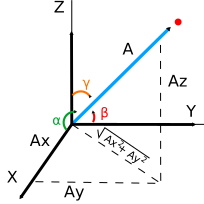
The direction cosines are the normalized components of \(\mathbf{A}\). They describe how the vector is oriented relative to the coordinate axes and are obtained by dividing each component by the vector magnitude.
A useful consistency check is that the direction cosines satisfy: