Force Along a Line
In statics, forces often act along a cable, rod, link, or line connecting two points. A force along a line is written by combining a magnitude with a unit direction vector that points along the line of action.
Concept
A force vector can be expressed as force magnitude \(\times\) direction. The direction is provided by a units vector along the line of action.
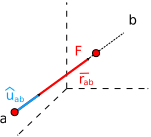
The unit direction vector \(\hat{\mathbf{u}}_{AB}\) points from point \(A\) to point \(B\). It is formed from the displacement vector \(\mathbf{r}_{AB}\).
Procedure
Procedure — Force Along a Line
Use two points on the line of action to build a displacement vector, normalize it, then multiply by the force magnitude.
-
1
Select two points on the line
Choose \(A(x_A,y_A,z_A)\) and \(B(x_B,y_B,z_B)\) on the force’s line of action.
-
2
Form the displacement vector
\[ \mathbf{r}_{AB}=\mathbf{r}_B-\mathbf{r}_A \] -
3
Compute its magnitude
\[ \|\mathbf{r}_{AB}\|=\sqrt{(x_B-x_A)^2+(y_B-y_A)^2+(z_B-z_A)^2} \] -
4
Create a unit direction vector
\[ \hat{\mathbf{u}}_{AB}=\frac{\mathbf{r}_{AB}}{\|\mathbf{r}_{AB}\|} \] -
5
Multiply by the force magnitude
\[ \mathbf{F}=F\,\hat{\mathbf{u}}_{AB} =F\left(\frac{\mathbf{r}_{AB}}{\|\mathbf{r}_{AB}\|}\right) \]
Vector Form Using a Displacement Vector
Combining the previous steps gives a compact expression for a force along the line from \(A\) to \(B\):
Here, \(\mathbf{r}_{AB}\) is the displacement vector pointing from \(A\) to \(B\), and \(\|\mathbf{r}_{AB}\|\) is its magnitude. The ratio \(\mathbf{r}_{AB}/\|\mathbf{r}_{AB}\|\) is a unit vector.
Worked Example — Force Along a Line
Problem
A cable is pulled with 30 lb of force. Write the force that acts on point A as a Cartesian vector and determine the direction of the force. All lengths shown are in ft.
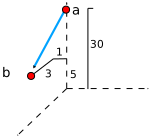
Use two points on the line of action. For the force at A (tension in the cable), the direction is from A to B.
The direction angles satisfy: \(\cos\alpha=\dfrac{r_x}{\|\mathbf{r}\|}\), \(\cos\beta=\dfrac{r_y}{\|\mathbf{r}\|}\), \(\cos\gamma=\dfrac{r_z}{\|\mathbf{r}\|}\).
- \(\mathbf{F}=(3.57\,\mathbf{i}-1.19\,\mathbf{j}-29.76\,\mathbf{k})\ \text{lb}\)
- \(\alpha=83.16^\circ,\ \beta=92.28^\circ,\ \gamma=172.80^\circ\)