Chapter 1 · Introduction
Units in Thermodynamics
Unit Systems
In thermodynamics, we primarily work with two unit systems: the International System of Units (SI) and the U.S. Customary (English) system. Many problems you solve will require converting between these systems or checking that your equations are dimensionally consistent.
The units of length, time, mass, and temperature are treated as fundamental units. Quantities such as force, energy, pressure, and power are derived units, constructed from the fundamental units using the physical relationships that appear in thermodynamic analysis.
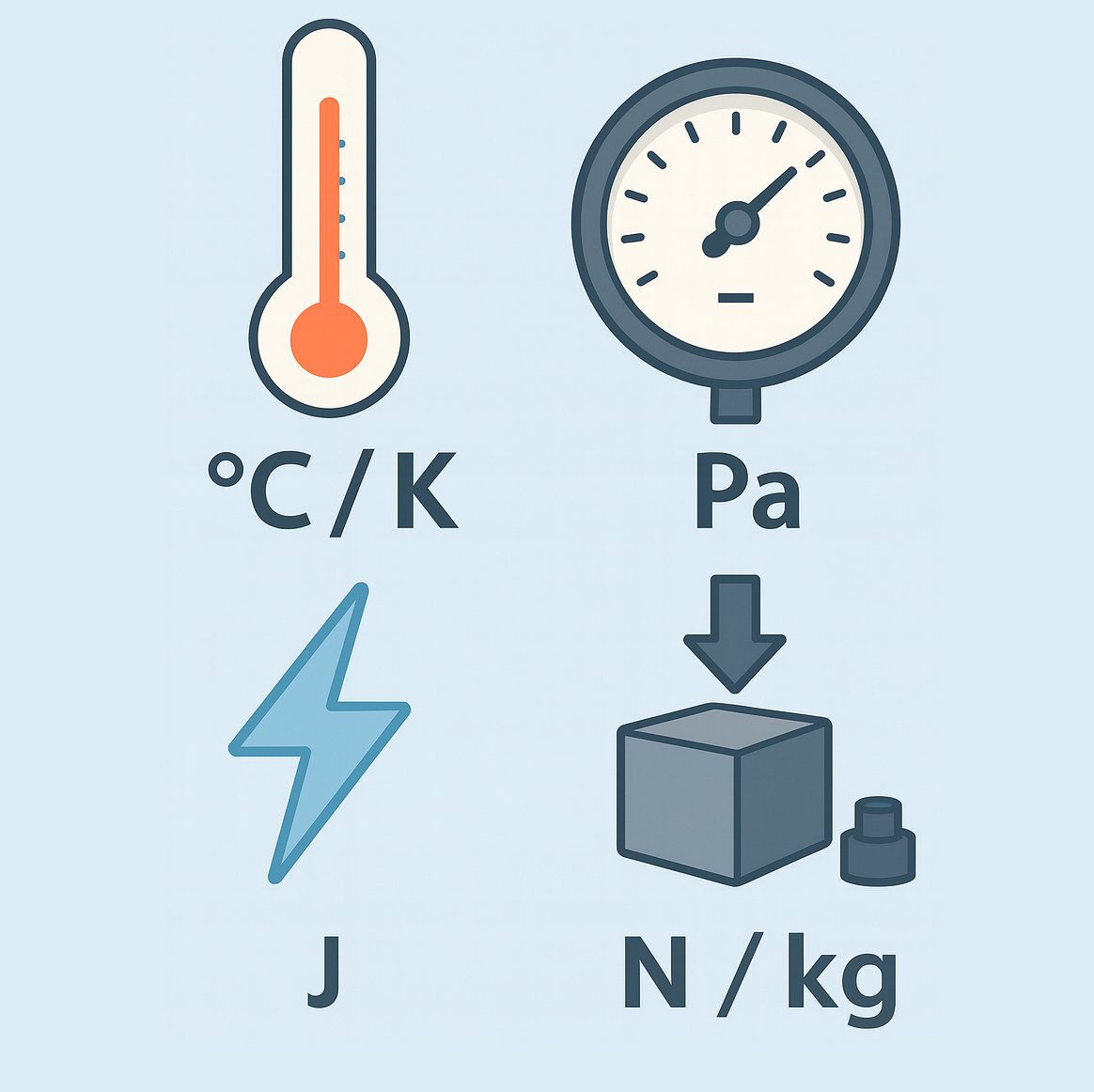
Common Thermodynamic Quantities and Their Units
The table below summarizes some of the most frequently used thermodynamic quantities and their standard units in SI and U.S. Customary systems.
| Quantity | SI Units | English Units |
|---|---|---|
| Length | meter (m) | foot (ft) |
| Mass | kilogram (kg) | pound mass (lbm) |
| Time | second (s) | second (s) |
| Force | newton (N) | pound force (lbf) |
| Temperature | degree Celsius (°C) | degree Fahrenheit (°F) |
| Temperature (absolute) | kelvin (K) | degree Rankine (°R) |
| Pressure | pascal (Pa) | pounds per square inch (psi) |
| Energy | joule (J) | British thermal unit (Btu) |
1 lbm weighs 1 lbf under standard Earth gravity
($g \approx 32.174~\text{ft/s}^2$). However,
lbm is mass and lbf is force. They are
linked through Newton's second law via gravitational acceleration, and
careful unit handling (often with a conversion factor such as
$g_c$) is required in dynamics and energy calculations.